Understanding the Nigeria Tax Act 2025: What Changed

The Nigeria Tax Act 2025, signed into law on June 26, 2025 and effective January 1, 2026, is the most significant overhaul of Nigeria's tax system since 1999. It consolidates over 60 scattered tax laws into one unified document, introduces new income brackets, expands small business exemptions, and zero-rates essential goods under VAT. This article covers every major change in plain language.
Quick Summary: What Changed
Here is everything that changed under the Nigeria Tax Act 2025, at a glance:
- Wider tax net — crypto, prizes, grants, and honoraria are now explicitly taxable
- New income tax brackets — zero tax on income up to ₦800,000; max 25% for earners above ₦50 million
- Small business threshold raised — from ₦25 million to ₦100 million turnover with full tax exemptions
- Capital gains tax increased for companies — from 10% to 30%
- VAT on essentials removed — rice, bread, medicine, school fees now zero-rated
- FIRS replaced by NRS — Nigeria Revenue Service with a Tax Ombudsman office added
Each change is explained in full detail below.
For a long time, paying tax in Nigeria felt like trying to solve a puzzle nobody gave you the full picture for.
There were too many different laws, too many confusing rules, and a system that seemed built for people who already understood it. If you were just a regular Nigerian trying to do the right thing, you were largely on your own.
The Nigeria Tax Act 2025 is the government's most serious attempt to fix that, signed into law by President Tinubu on June 26, 2025, and it started working on January 1, 2026. Before this law, Nigeria had over 60 different taxes scattered across multiple documents but the new law pulled everything into one place which now makes compliance easier for everyone.
But what really changed? Here is the simplest breakdown you will ever get.
The Tax Net Is Now Wider
The old law had blind spots. A lot of income types were either ignored or handled inconsistently which the new law aims to fix.
For instance, if you earn money from cryptocurrency, win a prize, receive a grant, or get paid an honorarium for a speaking engagement, that income is now officially taxable. These things existed before but the law did not clearly address them.
Also, the rules around who counts as a Nigerian taxpayer have been tightened. If you live between Nigeria and another country but your main business, family, and economic life is here, Nigeria now considers you a resident for tax purposes. You cannot use the fact that you travel frequently to argue that you do not owe taxes here.
There is also a new requirement for every Nigerian involved in any financial transaction to have a Tax Identification Number, commonly called a TIN. Fortunately, you do not need to visit a tax office or fill out endless paperwork to get one. The government has linked the databases so that your National Identification Number (NIN) automatically serves as your Tax ID. Since more than 80% of Nigerians already have a NIN, you automatically have a TIN.
This is how the government plans to bring the informal economy — traders, freelancers, artisans — into the official tax net.
Also read: Crypto Taxation in Nigeria: What the NTA 2025 Says — for readers who want to understand how their crypto income is now taxed
Personal Income Tax
This is the change that touches the highest number of Nigerians directly, and for most people it is actually good news.
Prior to this time, less than 20% of Nigerians paid income tax and to ease the burden on everyday workers, the new tax law completely changes who has to pay. If your net income — that is what you have left after business expenses — is ₦800,000 or less a year, your tax rate is 0%.
This means, if you earn more than ₦800,000 in a year, you have entered the tax-eligible bracket and from here it goes up progressively, capped at 25% for people earning above ₦50 million per year.
Also read: Tax Deductions in Nigeria 2025: 5 Claims Most Nigerians Are Missing — for readers who want to legally reduce the income they are taxed on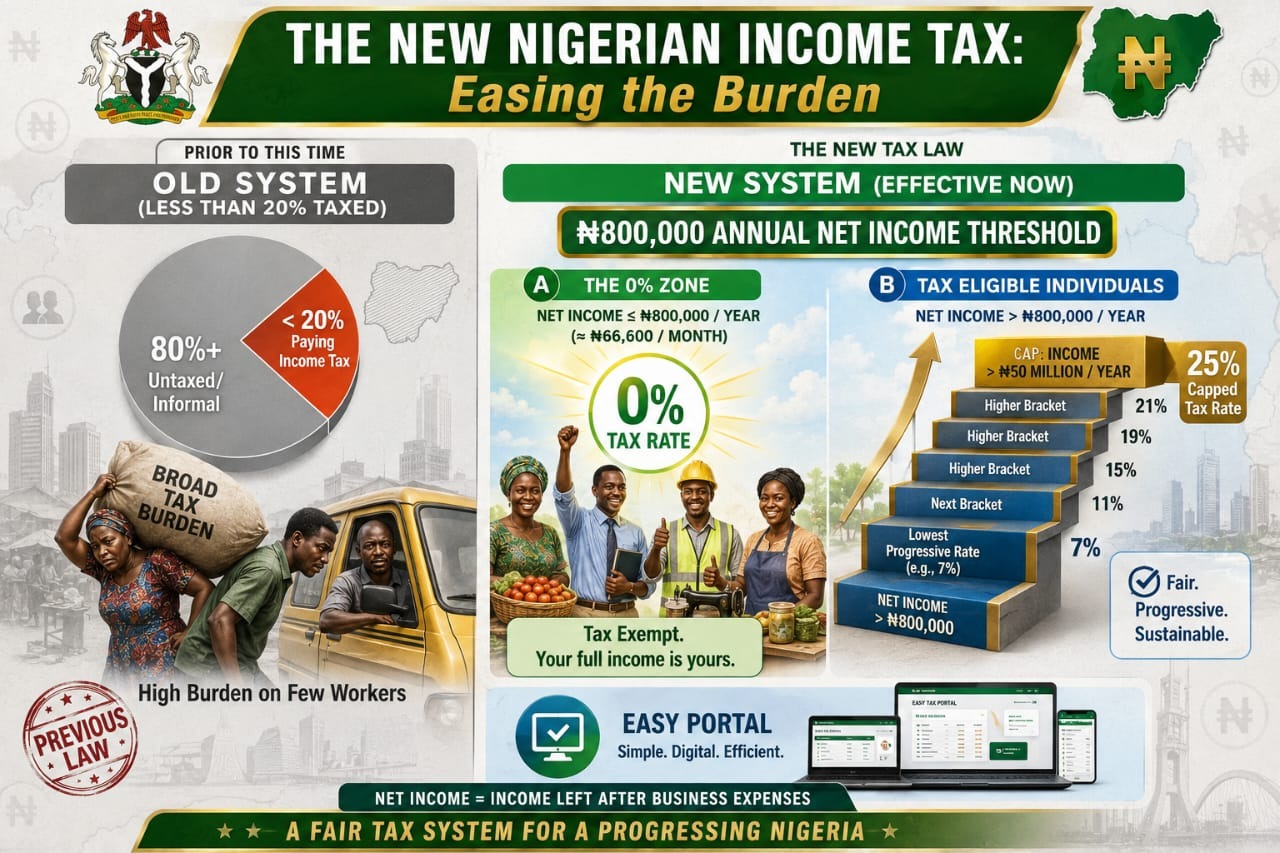
There is also a new rent relief. If you pay rent, you can now deduct 20% of your annual rent from your taxable income, up to a maximum of ₦500,000. So if you pay ₦1.2 million in rent per year, you can subtract ₦240,000 from what the government uses to calculate your tax.
Previously, this benefit was hidden inside a now abolished general tax break called the Consolidated Relief Allowance (CRA), making it difficult to see or track. Now it is a standalone perk that you can claim by simply providing your rent receipt from your landlord.
One other thing that changed under the new tax laws is with regards to gratuity: if your employer gives you a lump-sum gratuity as part of your retirement or end-of-service arrangement, it is completely tax-free and exempt from Personal Income Tax (PIT). The ₦50M limit you might hear about only applies to compensation for loss of employment like being laid off. So for those of you that have aged parents who are retiring, do let them know that their standard retirement gratuity cannot be taxed.
There is also a provision for people who lost a job or had an injury and received a lump sum as compensation — up to ₦50 million is exempted from tax, a 4x growth from the old limit of ₦10 million. For workers who receive large severance packages, this is meaningful protection.
Also read: How to Read Your Bank Statement for Tax Purposes — for readers who want to understand how their income and deductions appear in their financial records
Small Businesses
If you run a business in Nigeria, this part of the law is a massive game-changer for your pocket.
Previously, the government only called you a "small business" if your total yearly sales (turnover) were ₦25 million or less, meaning if you made a single Naira more, you were slammed with heavy corporate taxes. However, the new law completely changed the game by raising that small business ceiling all the way to ₦100 million. This means thousands of businesses that used to be trapped in the expensive "medium business" lane are now safely inside the tax-free small business category.
Being legally recognized as a small business means you no longer have to bleed cash to the taxman. Here is exactly what you get:
- 0% Income Tax: The government charges you zero Naira on your business profits. Every single Kobo stays in your account.
- Full Invoice Payments: No more Withholding Tax (WHT) drama. When you do a job for a corporate client, they must pay you your full money upfront with no deductions allowed.
- Zero VAT Headaches: You do not need to add VAT to your invoices, nor do you need to worry about filing VAT returns every month.
- Aggressive Deductions: If your business grows and starts approaching that ₦100 million limit, the law allows you to fully deduct any valid expense "wholly and reasonably" spent to run your business, shrinking what you owe.
As a qualifying small business, you are now fully exempt from three major financial burdens:
- Companies Income Tax (CIT)
- Capital Gains Tax (CGT) — tax on profits made from selling business assets like vans or land
- The New Development Levy
For larger companies that make over ₦100 million, the government replaced the chaos of multiple corporate levies with a single, flat 4% Development Levy on corporate profits. One charge instead of four. Simpler to understand, calculate, and pay.
Also read: Freelancers in Nigeria: Are You Overpaying Tax? — for self-employed readers who want to know which of these small business benefits apply to them
Capital Gains Tax
Capital Gains Tax is the tax you pay when you sell a valuable asset like land, buildings, or business equipment at a profit.
According to the new tax act, "personal chattels" like your private car or personal electronics are not taxed, which means most taxable events happen when someone disposes of commercial investments and physical business property like land or corporate buildings.
Here is how asset sales are being taxed:
- For individuals: the profit from selling an asset is added into their Personal Income Tax (PIT) and the tax rate is applied progressively based on how much they earn.
- For large companies: the Capital Gains Tax rate on asset sales increased from 10% to 30%. That is a meaningful jump.
- For small businesses: there is no Capital Gains Tax at all when selling business assets if your total annual turnover is ₦100 million or less.
The law also now taxes a type of asset transaction that used to escape notice. Some people structured their ownership of Nigerian assets through companies registered outside Nigeria to avoid paying local tax when they sold. The new law says that if the asset being sold derives most of its value from physical things located in Nigeria, Nigeria gets to tax that gain regardless of where the transaction is structured.
For regular share sales, the exemption threshold has been raised. If you sell company shares worth less than ₦150 million in a year and the profit does not exceed ₦10 million, you pay no Capital Gains Tax. The old limit was ₦100 million. And if you reinvest the proceeds into another Nigerian company, the entire amount is exempt with no upper limit applied.
Also read: Tax Deductions in Nigeria 2025: 5 Claims Most Nigerians Are Missing — specifically the bad debt write-off and pre-commencement expense deductions relevant to business owners
VAT and Everyday Goods
VAT stands for Value Added Tax. In plain terms, it is a consumption tax — meaning a tax you pay whenever you buy or consume certain goods and services in Nigeria.
The standard VAT rate in Nigeria stays firmly at 7.5%. While there were heavy discussions about raising it to 10%, that proposal was ultimately rejected to shield citizens.
Instead of raising the rate, what actually changed is how the government protects your daily wallet. The law expanded the list of essential goods and services that are zero-rated, meaning 0% VAT is added to the price. This protected category includes:
- Basic food items: everyday essentials like rice, flour, cooking oil, fish, vegetables, bread, and milk
- Healthcare and Education: medical products, hospital services, educational materials, and school tuition fees
- Utilities: electricity used for generation and transmission
Pro-Tip for Consumers: Because these items are strictly 0% VAT, check your supermarket or pharmacy receipts. If you notice a business charging you VAT on these basic goods, you now have a legal right to report them for free to the newly created Tax Ombudsman Office.
For registered business owners, the law introduced a highly anticipated change on the input side of VAT. Previously, a company could only recover the VAT it paid on physical raw goods used directly for production or resale. The new law fixed this. Businesses can now recover and offset the VAT they pay on services they procure and on equipment or fixed assets they buy.
Also read: How to Read Your Bank Statement for Tax Purposes — for understanding how VAT charges appear on your records
A New Tax Authority
The Federal Inland Revenue Service (FIRS), the body most Nigerians associate with tax collection at the federal level, has officially been replaced by the Nigeria Revenue Service (NRS). The new body has a broader mandate and is built to handle digital compliance, including real-time VAT reporting and electronic invoicing.
Alongside this agency change, a Tax Ombudsman office has been created. This is an independent office that takes complaints from taxpayers about how they have been treated by the tax authorities. If you believe you were wrongly assessed or unfairly handled by tax agents, this is the office you go to. Before now, if you had a problem with the FIRS, your only real option was a costly fight through the courts. Having an independent intermediary is a meaningful step toward a fairer system.
What This All Means for You
- For Low-Income Earners: if you earn a low income, you are better off under this law than you were before.
- For Small Businesses: if you run a small business making under ₦100 million in annual turnover, your tax burden has been reduced significantly.
- For Everyday Shoppers: if you buy basic food items, pay for medical care, or clear your children's schooling fees, you will not pay a single Kobo of VAT on those things.
- For High Earners and Investors: if you invest in assets, sell company shares, or own a corporation with significant capital activity, the rules are stricter now and the rates in some areas are higher. That side of the law demands much more attention.
The Nigeria Tax Act 2025 will only be as effective as its enforcement. But the intent is clear: a simpler system, a wider net, and more protection for people at the lower end of the income scale. Whether that plays out fully in practice depends on what comes next.
Taxidy is built by Nigerians who understand exactly how confusing this system is.
Sources: Nigeria Tax Act 2025 (Sections 3, 4, 20, 30, 163). Verified against the official NTA 2025 document. Additional reference: PwC Nigeria Tax Alert, EY Nigeria Tax Summary 2025, Mondaq Nigeria.
Ready to know your real tax position?
Upload your bank statement and see your tax estimate in minutes.
Get Started